Equalis OpsReg product overview
A compliance evaluation platform for Azure. It reads subscription metadata, applies 437 deterministic rules and keeps the results as evidence. It never changes your environment.
What the platform does
Rule-based evaluation
437 rules, each comparing Azure resource properties with a named framework requirement. Results are pass, fail or not assessed.
Scoring per framework
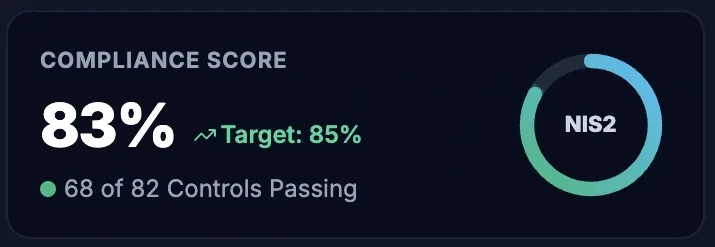
A compliance score for each framework and each subscription: passing rules divided by the framework's rule count, compared with the target you set.
Evidence records
Every result is stored with the rule version, resource, property, expected and actual values, and timestamps.
PDF exports
Evidence reports per framework, scoped to a named subscription, ready for an auditor or a supervisor.
Remediation workflow
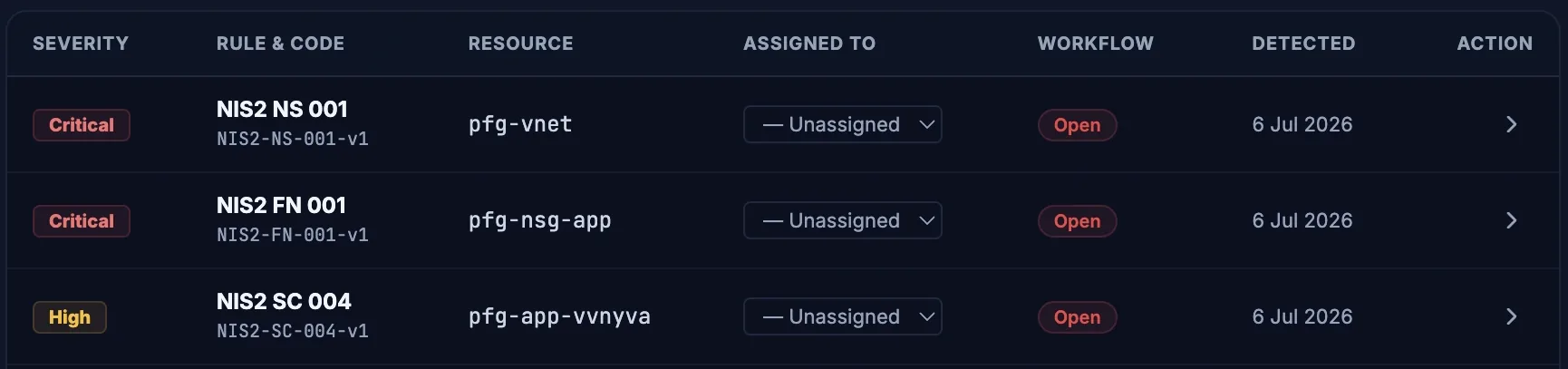
Assign findings, track them and mark them as addressed. The next scan confirms the fix; the platform never applies it.
Seven connectors
Microsoft Teams, Slack, email, Jira, ServiceNow, PagerDuty and webhooks, on both plans.
The framework dashboard
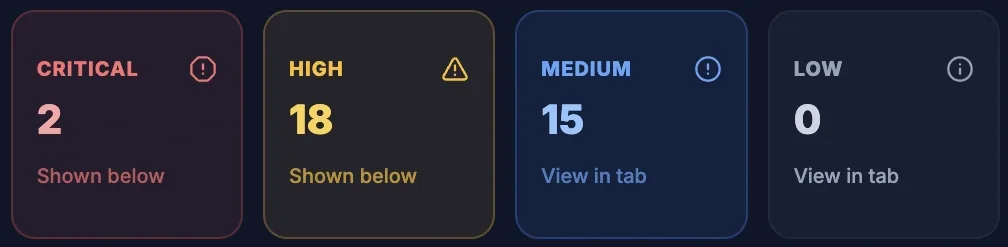
The NIS2 view of a subscription, in three parts: the score against your target, open findings by severity, and the finding table with assignment and workflow status. Sample data.
Your estate, by service
The dashboard opens on the Service view: the resources of a subscription grouped into the services your organisation runs, each with its open findings by severity and a criticality that you set.
Illustration with sample data.
Four grouping methods, one order of precedence
Manual selection, then resource group, then tag, then name prefix. A resource belongs to one service only. Tags are the primary method: the platform reads them and never writes them.
Criticality is yours to set
Critical, Important or Standard, with Standard as the default. The platform never infers or suggests it, and criticality never changes a finding, a severity, a score or an evidence record.
Preview before you save
Every change shows the matched items, the conflicts with higher-precedence placements and what moves to Unassigned. Saving regroups the latest scan's evidence for that subscription; no rule is re-evaluated and nothing is rewritten.
Every change is audited
Service and criticality changes are recorded with the actor, the time and the before and after values, in the same transaction as the change.
Framework coverage
All five frameworks are included in both plans.
| Framework | Rules | Scope |
|---|---|---|
| GDPR | 74 | Articles 5, 25 and 32 |
| NIS2 | 82 | Article 21 risk-management measures |
| DORA | 81 | Chapter II, ICT risk management |
| ISO/IEC 27001:2022 | 90 | Annex A, mainly technological controls |
| PCI DSS v4.0.1 | 110 | Requirements that depend on cloud configuration |
| Total | 437 |
What the platform does not do
Inform, Don't Act. It holds no write permission, pushes no policy and changes no resource. No feature can be switched on to give it that ability.
It evaluates technical configuration. Organisational measures such as policies, training, contracts and risk assessments remain your responsibility and are not scored by the platform.
- No write access to customer subscriptions
- Platform data stored in Azure North Europe, with backups in West Europe
- No data read outside the connected subscriptions
- No statistical models in the evidence path
Contact
Demonstrations are run in French or English, in thirty minutes, by the people who build the platform.
The Black Church, St. Mary's Place
Dublin 7, D07 P4AX, Ireland
contact@equalistech.comRequest a demonstration (opens in a new tab)